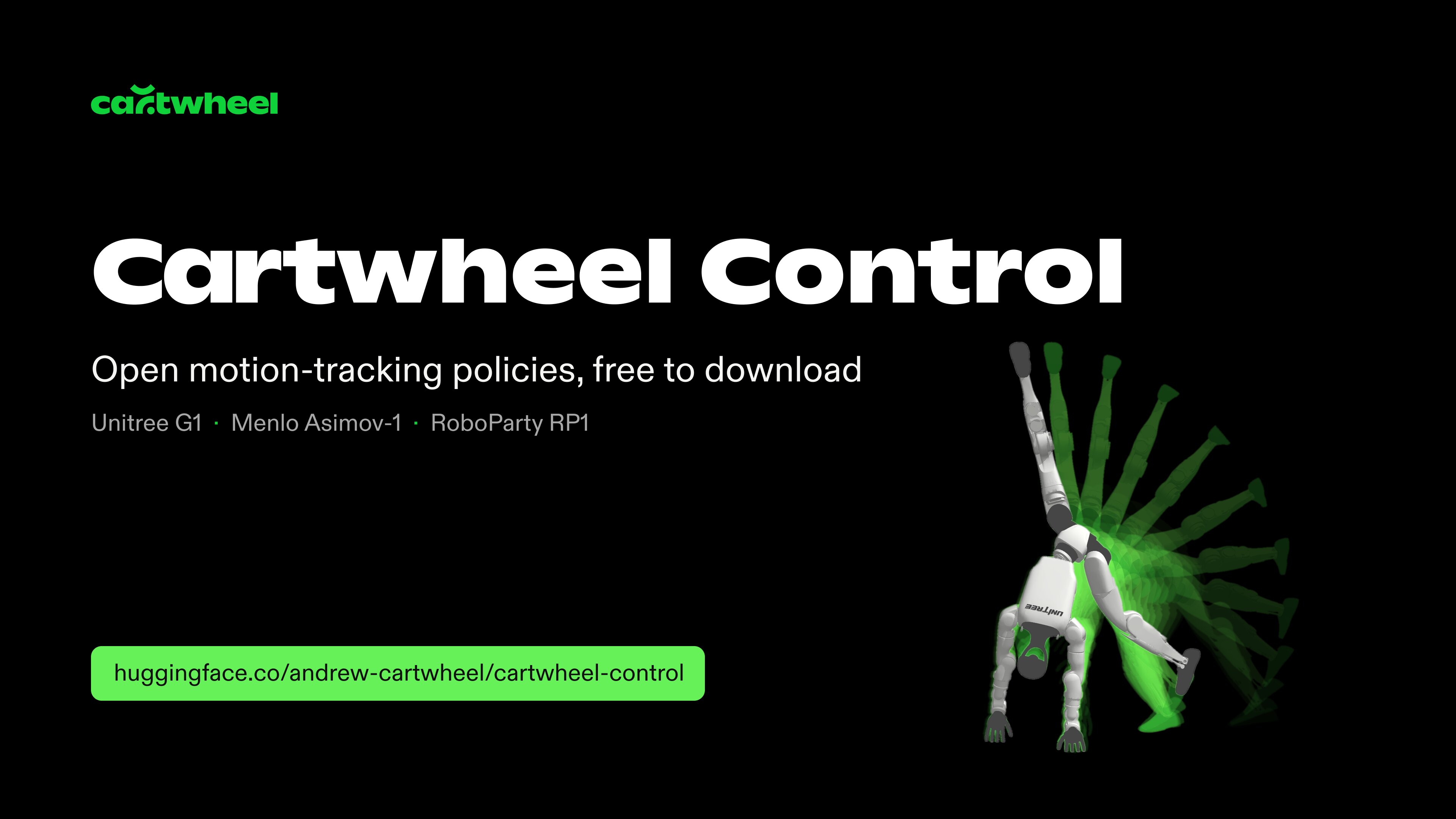
Today we’re introducing Cartwheel Control: our hardware-agnostic approach to training whole-body motor control policies from large-scale kinematic motion. To kick it off, we’re releasing three open motion-tracking policies for humanoid robots, free to download on Hugging Face alongside Apache-2.0 simulation and visualization code on GitHub.
Give any of these policies a reference motion and it drives the robot’s joints at 50 Hz to perform it in physics simulation. We started with three very different humanoid bodies:
- Unitree G1 (29 joints)
- Menlo Asimov-1 (25 joints)
- RoboParty RP1 (28 joints)
Three morphologies, three actuator profiles, three distinct sets of physical compromises. One lacks waist pitch. Another is a compact 35-kilogram frame with tight ankle and knee limits and high armature relative to torque. All three track everything from subtle weight shifts, waves, and footwork to high kicks and ground recoveries—right up to G1 throwing an actual cartwheel and RP1 sticking a 360-degree backflip into a kneeling landing.
Download on Hugging FaceView code on GitHub
Kinematics Are Essential for Whole-Body Control
There is a popular temptation in robotics right now to treat kinematics as legacy scaffolding. Feed raw camera pixels into a large network, output joint torques end to end, and hope scale sorts out everything in between.
Maybe you can get away with that for a single arm bolted to a tabletop. You cannot get away with it on a biped.
A humanoid robot is in a continuous, whole-body negotiation with gravity. Every reach of the hand shifts the center of mass over the feet. Every turn winds momentum through the ankles, knees, pelvis, and spine. The difference between stepping forward cleanly and face-planting—or between a gesture that reads as natural and one that looks like a servo fault—lives in the geometry and timing of how the whole body moves together in 3D space.
That geometry is kinematics.
Kinematics give whole-body control a clean, physically meaningful coordinate system to organize around. They separate what the body is trying to express in space from how a specific set of motors, gears, and links has to fight inertia and friction to make it happen. Try to learn complex humanoid behavior without strong kinematic structure and your controller spends most of its capacity rediscovering basic posture and balance from scratch.
Why Data and Algorithm Have to Meet
Tracking dynamic motion to within 15–20 mm on three different robots isn’t just about the RL recipe. The motion data matters as much as the algorithm.
On the algorithmic side, Cartwheel Control builds on a modified SuperMimic architecture. Instead of relying purely on brute-force model-free rollouts, we pair GPU physics simulation with a learned world model so the policy can practice tracking short future windows of reference motion in imagination alongside real simulator transitions. On top of that foundation, we introduced our own changes around state normalization, critic stability, clean action conditioning, and multi-stage curriculum training. Those details end up mattering enormously when you train long runs and port the same recipe onto new robots whose torque-to-inertia ratios and joint limits look nothing like the robot you started on.
Still, even the cleanest control algorithm will fall apart if you feed it bad motion.
Most robotics pipelines quietly starve their policies on messy kinematics: feet sunk two centimeters into the floor, sliding contacts, sudden joint-angle jumps that send simulated limbs spinning, or small mocap sets that barely scratch the surface of how people actually move. When your reference trajectories violate basic physical intuition, the policy is forced to invent ugly compensations just to stay upright.
At Cartwheel, we have spent the last two years obsessing over the motion data problem—across video performance capture with Comic, sequence-level generation with Swing Choreo, and cross-embodiment retargeting with Cartographer. Because our data pipeline treats ground contact, weight transfer, temporal continuity, and embodiment-aware retargeting as first-class constraints, the trajectories going into policy training are already coherent and physically grounded. Clean, diverse kinematics turn whole-body policy training from a fragile art project into an engineering loop you can repeat on new hardware.
Generative Kinematics + Motor Control = The Unlock
Look at those two layers side by side and it becomes clear how robotics actually opens up.
Generative kinematics alone gives you a ghost. A motion model can imagine a complex multi-beat performance—walk across the room, wave to someone in the doorway, crouch down to inspect an object—complete with natural timing and believable non-verbal body language. On its own, though, kinematic motion doesn’t respect gravity, torque saturation, or floor friction.
A motor control policy alone has the opposite problem. It knows how to keep a specific piece of hardware balanced under real physics, and it can execute whatever trajectory you hand it, down to a backflip. On its own, though, it has no idea what to do next when someone walks into the room or gives an open-ended instruction.
Put a strong generative kinematic model above a rock-solid whole-body control policy and each half unlocks the other:
- Generative kinematics handles intent, sequence, and expression. Conditioned on language, scene context, or a high-level planner, it produces rich 3D reference motion on the fly.
- Whole-body motor control handles embodiment and physics. Running at 50 Hz, it reads the next fraction of a second of that kinematic target and drives real actuators smoothly without losing balance.
Best of all, this interface decouples scaling. Earlier this year we published compute-optimal scaling laws for human motion, showing that 3D motion generation improves predictably as we scale data and compute. When your robot has a capable whole-body tracking policy, every leap forward in generative human kinematics immediately becomes a capability upgrade for the robot—without collecting thousands of hours of fresh teleoperation for every new behavior or every new hardware revision.
Standing on Open Shoulders
Robotics is moving fast right now because teams are putting real code, models, and hardware specs into the open.
We want to give real credit where it’s due. The research lineage around BeyondMimic and SuperMimic showed just how far whole-body tracking can go when simulation and world modeling are combined thoughtfully. The teams behind MuJoCo Warp and mjlab made high-throughput GPU physics clean enough that small teams can iterate at serious speed. And hardware builders like Menlo Research (with the open-source Asimov-1 design), RoboParty (RP1), and Unitree (G1) have made capable humanoid embodiments accessible to the broader community.
We packaged Cartwheel Control so anyone with a Linux GPU machine can run any of the three policies in a couple of minutes:
git clone https://github.com/Cartwhl/cartwheel-control && cd cartwheel-control
uv sync
uv run cartwheel-play --robot rp1
python -m http.server -d play_out/viewer 8000
That single command pulls the weights, robot models, and example motions from Hugging Face, simulates them in parallel, and writes out a self-contained web viewer where you can inspect the physics rollout right on top of the kinematic reference ghost—or point --motions at a folder of your own trajectories and see what holds up.
Build With It—or Build With Us
These three policies are simulation releases. They haven’t been deployed onto physical hardware yet, and we’re releasing them openly so researchers, hobbyists, and robotics engineers can stress-test them, throw strange motions at them, wire them up to planners or generative models, and use them as a strong starting point for sim-to-real work.
Go download the weights on Hugging Face, poke around the code on GitHub, and see what you can make G1, Asimov-1, and RP1 do.
And if you’re building your own robot—whether it’s a new humanoid, a wheeled manipulator, or a custom character platform—the hardest parts of this stack are usually sourcing clean, physically grounded motion data at scale and getting whole-body policies dialed in for your specific kinematics and actuators. That is what our infrastructure was built for. If you need custom motion training data tailored to the behaviors your robot needs to learn, or want to partner with us on custom control policies for your embodiment, reach out to our team. We’d love to build with you.